$66.59
$120.53
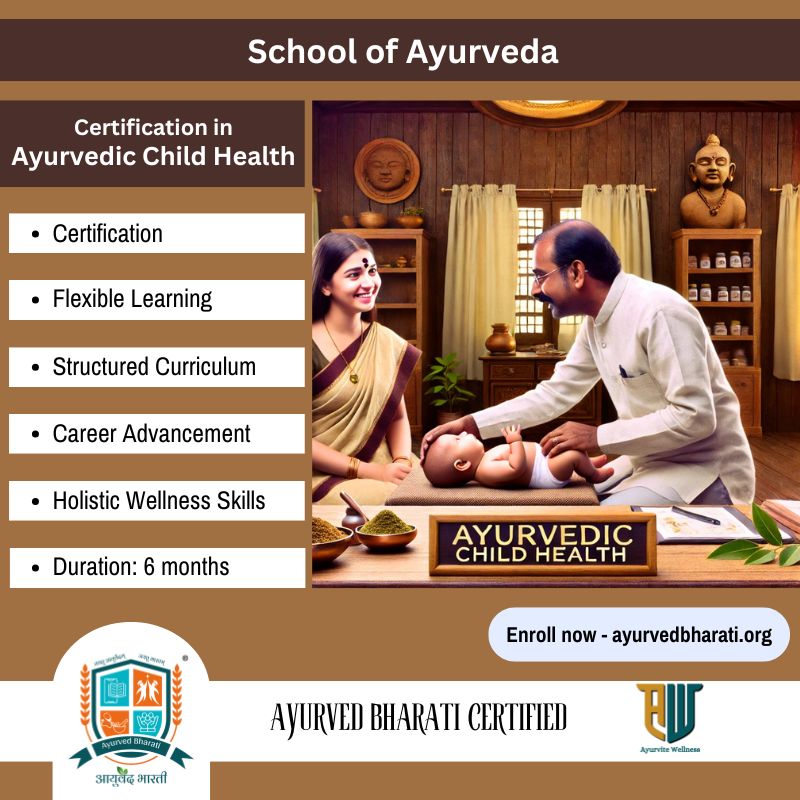
Gain specialized knowledge in Ayurvedic approaches to pediatric health with our Certificate in Ayurvedic Child Health course. This unique program delves into the holistic Ayurvedic principles for supporting the health, growth, and development of children. Designed for healthcare professionals, Ayurvedic practitioners, and anyone passionate about natural child healthcare, this course covers everything from newborn care to managing common childhood illnesses using time-tested Ayurvedic methods.Course OverviewCourse Duration: 3 monthsEligibility: Healthcare professionalsMode of Education: OnlineCertification: Receive a certificate awarded by Ayurved Bharati, providing credible validation of your skills.LMS and Digital Library Access: Access to a Learning Management System (LMS) and digital library developed by the experts, filled with resources on Ayurvedic pediatrics and holistic child health practices.Why Choose the Certificate in Ayurvedic Child Health?Online flexible Learning: Enjoy the convenience and flexibility of online learning at your own time and place.Comprehensive Resources: Access a variety of resources via the LMS and digital library, supporting a deep understanding of Ayurvedic child health.Specialized Curriculum: Learn Ayurvedic principles tailored specifically for pediatric health, with a focus on safe and effective natural practices.Course Highlights1. Comprehensive CurriculumThis certificate course is designed to take you from core Ayurvedic principles (as they apply to children) to a strong, clinical understanding of Kaumarbhritya, and finally into a high-end scholar track where you learn to handle recurrence, chronicity, protocols, and nuanced decision-making. The flow is simple: foundation → pediatric application → disease mastery → advanced integration.Total learning units: 72 lessons (12 weeks × 6 lessons/week)Assessments:End of Month 1: Self-assessment quiz (10 MCQs)End of Month 2: Self-assessment quiz (10 MCQs)End of Month 3: Final assessment (30 MCQs)Month 1 — The Essentials (Ayurveda Kaumarbhritya Core) Month 1 builds your “pediatric Ayurvedic brain”: how dosha behaves in a child, how agni collapses faster, why ojas matters so much, and how to think in Panchanidana without overcomplicating.Week 1 — Ayurveda Basics, Rebuilt for PediatricsLesson 1.1 Tridosha fundamentals, the pediatric way: what Vata/Pitta/Kapha look like in childrenLesson 1.2 Sapta Dhatu with a growth lens: dhatu poshana and why kids shift quicklyLesson 1.3 Agni and Ama: how pediatric digestion creates disease (and how it resolves)Lesson 1.4 Srotas essentials for child health: annavaha, pranavaha, rasavaha, purishavaha, mutravahaLesson 1.5 Ojas, Bala, Vyadhikshamatva: how “immunity” actually shows up in a childLesson 1.6 Shadkriyakala Samprapti: catching illness early before it becomes heavyWeek 2 — Kaumarbhritya Fundamentals (The Pediatric Rules of Ayurveda)Lesson 2.1 Kaumarbhritya scope and age groups: the logic behind “child is sukumara”Lesson 2.2 Pediatric history that matters: feeding, sleep, stool/urine, milestones, recurrence patternsLesson 2.3 Pediatric examination in real terms: bala grading, dehydration clues, danger signsLesson 2.4 Prakriti vs Vikriti in children: what remains stable and what changes fastLesson 2.5 Ahara-vihara for children: dinacharya, ritucharya, satmya, pathya-apathyaLesson 2.6 Pediatric dosing mindset: matra, anupana, tolerance, and safe sequencingWeek 3 — Nutrition, Growth, Development (Where Most Pediatric Practice Begins)Lesson 3.1 Stanya and early feeding: breastfeeding support through Ayurvedic reasoningLesson 3.2 Complementary feeding: textures, timing, appetite rhythm, and agni protectionLesson 3.3 Growth patterns and bala: when “thin child” is normal and when it isn’tLesson 3.4 Developmental milestones: functional markers red-flag delays (clear, practical)Lesson 3.5 Picky eater and junk-food loop: why it happens and how to reverse itLesson 3.6 Pandu-tendency and deficiency patterns: early clues, diet logic, monitoring pointsWeek 4 — Clinical Thinking Tools (Panchanidana Made Usable)Lesson 4.1 Panchanidana in pediatrics: hetu → purvarupa → rupa → upashaya → sampraptiLesson 4.2 Differential diagnosis: separating “dosha pattern” from “disease label”Lesson 4.3 Ama vs Nirama: the decision that changes everything in treatment orderLesson 4.4 Acute vs chronic approach: langhana, deepana-pachana, brimhana—when and whyLesson 4.5 Parent communication: how to explain illness, diet, and monitoring without confusionLesson 4.6 Month 1 high-yield revision lesson (the cleanest recap you’ll want before the quiz)End of Month 1: Self-Assessment Quiz (10 MCQs)Month 2 — Common Pediatric Diseases (Signs, Diagnosis, Panchanidana, Treatment) Month 2 is where you gain confidence: common pediatric presentations, their Ayurvedic mapping, and the complete clinical handling—from symptoms and panchanidana to chikitsa planning.Week 5 — Jvara (Fever) as a SpectrumLesson 5.1 Understanding jvara in children: types, stages, ama vs niramaLesson 5.2 Panchanidana of jvara: what to ask, what to observe, what it meansLesson 5.3 Fever patterns and safety: when it’s simple and when it’s seriousLesson 5.4 Chikitsa principles: langhana, pachana, pathya, hydration, monitoringLesson 5.5 Classical medicines used in pediatric fever care (selection by principle, not memorization)Lesson 5.6 Complications and escalation: dehydration risk, febrile seizures, danger signsWeek 6 — Respiratory: Pratishyaya, Kasa, Shwasa PatternsLesson 6.1 Pratishyaya in children: types, lakshana, samprapti, upashayaLesson 6.2 Kasa patterns: dry vs wet, night worsening, dosha cluesLesson 6.3 Shwasa warning patterns: wheeze-like signs and urgent indicatorsLesson 6.4 Chikitsa principles: kapha-ama clearance, agni stabilization, relapse controlLesson 6.5 Classical medicines supportive measures (age-wise logic and safety)Lesson 6.6 Prevention protocol for recurrence: season, diet triggers, routine disciplineWeek 7 — Gastrointestinal: Atisara, Chhardi, Udarshoola, Grahani-Tendency, KrimiLesson 7.1 Atisara: dehydration recognition, ama stage care, recovery dietLesson 7.2 Chhardi (vomiting): patterns, panchanidana, clinical handlingLesson 7.3 Udarshoola: vata gas vs ama heaviness vs krimi hints (clear differentiation)Lesson 7.4 Grahani-tendency: chronic loose stools, fatigue, agni impairment frameworkLesson 7.5 Classical medicines: deepana-pachana → grahi → brimhana sequencingLesson 7.6 Krimi in children: signs, prevention mindset, chikitsa principlesWeek 8 — Skin & Allergy-like Presentations in ChildrenLesson 8.1 Twak roga basics: dosha-dushya-srotas in pediatric skin disordersLesson 8.2 Kandu/pidika/urticaria-like patterns: triggers, panchanidana, diary methodLesson 8.3 Safety first: drug reactions, severe allergy signs, when to seek urgent careLesson 8.4 Chikitsa principles: shamana focus, external care, shodhana suitability basicsLesson 8.5 Classical medicines used in itching/rash patterns (principle-based selection)Lesson 8.6 Prevention: gut–skin axis (agni–ama) seasonal trigger controlEnd of Month 2: Self-Assessment Quiz (10 MCQs)Month 3 — Advanced Scholar Track (Protocols, Procedures, Complex Reasoning) Month 3 is intentionally “high level.” You’ll learn how scholars think: protocol design, recurrence logic, cautious use of procedures, and documentation that stands up to real clinical practice.Week 9 — Ojas, Rasayana, and Recurrence ProtocolsLesson 9.1 Vyadhikshamatva deep dive: ojas markers and bala gradingLesson 9.2 Rasayana in pediatrics: indications, boundaries, monitoring outcomesLesson 9.3 Recurrent URTI protocol: agni correction → rasayana → relapse preventionLesson 9.4 Allergy-tendency protocol: ama control diet discipline season strategyLesson 9.5 Brimhana in weak children: dhatu poshana planning (practical and safe)Lesson 9.6 Integrated case reasoning: recurrent infections with poor appetite and low staminaWeek 10 — Behavior, Sleep, Screen-Stress (Manovaha Srotas in Modern Life)Lesson 10.1 Sleep–agni–behavior triangle: why routine acts like medicineLesson 10.2 Screen overuse and attention issues: Ayurvedic interpretation reset frameworkLesson 10.3 Tantrums/anxiety-like patterns: sattva support family counseling logicLesson 10.4 Bedwetting tendency (conceptual): vata-kapha patterns and routine strategyLesson 10.5 Learning difficulties: what Ayurveda can support and where referral beginsLesson 10.6 Integrated case: irritable child with constipation, sleep disturbance, appetite lossWeek 11 — Panchakarma & Procedures in Children (Only Where Appropriate)Lesson 11.1 Pediatric suitability principles: bala, mridu kostha, contraindicationsLesson 11.2 External therapies: abhyanga, gentle swedana, lepa—clinical use casesLesson 11.3 Nasya concepts in older children: indications precautionsLesson 11.4 Basti concept (scholar track): when it is considered and why safety dominatesLesson 11.5 Shodhana vs shamana: decision logic in pediatric contextLesson 11.6 Integrated case: chronic respiratory pattern—where procedures fit (and where they don’t)Week 12 — Protocol Design, Research Thinking, and Clinical DocumentationLesson 12.1 A scholar’s case reading: dosha–dushya–srotas framework in one flowLesson 12.2 Designing condition-wise protocols: acute recurrence prevention layersLesson 12.3 Integrative counseling clarity: antibiotics/vaccines questions without conflictLesson 12.4 Pediatric drug safety follow-up: dosing logic, monitoring, warning signsLesson 12.5 Research mindset: outcome measures, follow-up endpoints, audit-ready notesLesson 12.6 Final high-yield revision lesson (everything pulled together cleanly)End of Month 3: Final Assessment Test (30 MCQs)2. Expert Faculty & interactive LMSExperienced Instructors: Learn from Ayurvedic doctors and experts with a focus on pediatric health.Videos and Digital notes: Gain additional insights through videos and notes, sharing best practices and case studies.3. Digital Library & LMS AccessDigital Library: Access a rich collection of eBooks, videos, case studies, and research papers on Ayurvedic child health and pediatrics.Learning Management System (LMS): The LMS provides structured access to course materials, assignments, quizzes, and discussion forums for seamless learning.Demo Lessons (preview) – Lesson 1 | Lesson 2 | Lesson 3Key Benefits of the Certificate in Ayurvedic Child HealthCertification: Gain a certificate of completion from India’s leading Ayurvedic educational institute, boosting your credentials in Ayurvedic pediatric health.Experienced Faculty: Learn from certified Ayurvedic pediatric specialists and healthcare professionals.Career Advancement: Prepares you for roles in wellness centers, Ayurvedic clinics, and pediatric healthcare facilities, or to start your own practice.Comprehensive Resources: Access the LMS and digital library for continuous learning and enrichment.How to EnrollStep 1: Visit Our WebsiteGo to ayurvedbharati.org/courses and navigate to the Certificate in Ayurvedic Child Health course page.Step 2: CheckoutFollow the checkout steps.Step 3: Complete the Registration FormFill in the registration form with your details, including your name, email, contact information, and any other required fields.Step 4: Make PaymentComplete the enrollment process by making a secure payment on our website.Step 5: Start Learning!Once enrolled, you will receive access to the digital library, LMS, course materials, and additional resources.Frequently Asked Questions (FAQs)What is the eligibility for the Certificate in Ayurvedic Child Health course?This course is open to anyone interested in Ayurvedic pediatric healthcare. There are no specific eligibility requirements.What is the mode of education for this course?The course is available in Online format.What topics are covered in this course?The course covers Ayurvedic pediatric fundamentals, neonatal and infant care, immunity building, nutrition, common childhood ailments, and safe herbal remedies.Do I need prior experience in Ayurveda to enroll?No, if you are from healthcare profession, this course will add on Ayurvedic paediatric skills on your knowledge set.Will I receive a certificate upon completion?Yes, upon successful completion, you will receive a certificate awarded by a Ayurved Bharati.How do I access the LMS and digital library?Upon enrollment, you will receive login credentials to access the LMS and digital library, which includes a variety of study resources and course materials.What is the fee structure for each duration option?The fees vary depending on the course duration. Please visit our website for specific fee details.Enroll Now: ayurvedbharati.org/coursesEnhance your knowledge of holistic child health with our Certificate in Ayurvedic Child Health. Enroll today to gain the skills and knowledge to support children’s wellness through the wisdom of Ayurveda!
Short Term Skill Courses